
In industrial equipment, displays often operate continuously for many years. Unlike consumer electronics, industrial devices such as control panels, medical instruments, test equipment, and automation systems require long-term reliability and stable performance. For this reason, LCD lifetime and reliability are critical considerations when selecting a display module.
Understanding the factors that influence LCD lifespan helps engineers design more reliable products and avoid unexpected failures during the product lifecycle.
This article explains the key factors that affect industrial LCD lifetime and how engineers can improve display reliability.
The backlight is usually the first component in an LCD module to experience performance degradation. Modern TFT LCD displays typically use LED backlights, which gradually lose brightness over time due to LED aging.
Backlight lifetime is commonly defined as the number of operating hours required for brightness to decrease to half of its original value. In many industrial LCD modules, the backlight lifetime can reach tens of thousands of hours depending on operating conditions.
Factors affecting LED backlight lifetime include:
Reducing LED current and improving heat dissipation can significantly extend backlight lifespan.

Temperature has a major influence on LCD reliability. Industrial devices often operate in environments with wide temperature variations, including outdoor installations or factory environments.
Extreme temperatures can affect several display components:
Industrial-grade LCD modules are typically designed with wider operating temperature ranges than consumer displays, allowing them to perform reliably in demanding environments.
Proper thermal management and enclosure design are essential to maintaining stable display performance.
Image retention, sometimes called temporary image persistence, may occur when static images remain on the screen for extended periods. Over time, certain pixels may temporarily retain residual patterns.
This effect is more noticeable in applications where the same graphical interface remains visible for long durations, such as industrial control panels.
To minimize image retention:
Modern TFT LCD panels are designed to reduce image retention, but proper system design can further improve long-term performance.
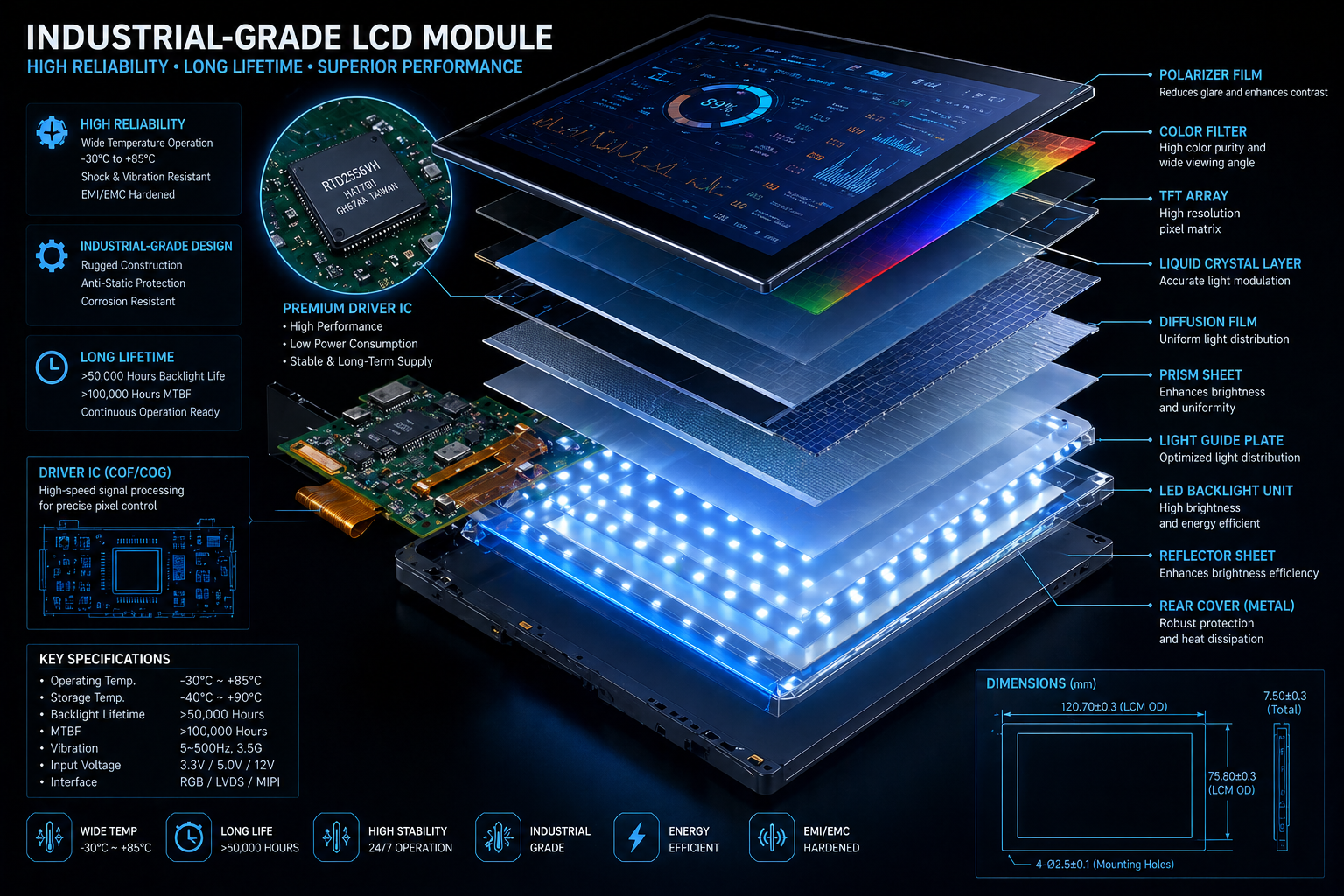
Industrial displays often operate in harsh environments where vibration, dust, or humidity may affect reliability. Mechanical durability is therefore an important factor when selecting a display module.
Design considerations may include:
In some industrial applications, optical bonding is used to improve mechanical stability and reduce internal reflections.
Environmental protection helps ensure that the display maintains stable performance throughout the product lifecycle.
Industrial equipment often remains in production for many years. Therefore, long lifecycle support from the display manufacturer is essential.
Engineers should confirm:
Reliable LCD manufacturers typically provide advance notice if a component becomes obsolete and may offer alternative solutions to maintain product continuity.
Engineers can improve display reliability by considering several design strategies:
Working closely with experienced display manufacturers can also help identify potential reliability risks early in the design process.
Industrial LCD displays must deliver stable performance for many years under demanding conditions. Factors such as backlight aging, operating temperature, mechanical durability, and supply chain stability all influence display lifetime.
By selecting the right LCD module and implementing proper system design strategies, engineers can significantly improve the reliability and longevity of their products.
Looking for long-life industrial LCD displays?
We support OEM manufacturers with reliable display solutions designed for long lifecycle applications.
Our capabilities include:
RFQ Information
Please provide the following information:
Our engineering team will recommend the most suitable display solution for your product.
Custom LCD Design Guide for OEM Products
LCD Display Cost Breakdown: What Determines the Price of a TFT Display
How to Choose a Reliable LCD Manufacturer for OEM Projects
TFT vs STN Cost Comparison: Which LCD Technology Is More Cost-Effective?
High Brightness LCD Cost Explained: What Really Drives the Price?