
Displays used in medical devices must meet stricter requirements than those used in consumer electronics. Applications such as patient monitors, diagnostic equipment, portable medical devices, and laboratory instruments require high reliability, stable performance, and long-term availability.
For engineers and procurement teams, selecting the right LCD display for medical devices involves more than just choosing size and resolution. It requires careful consideration of optical performance, durability, regulatory expectations, and lifecycle support.
This guide outlines the key requirements when selecting displays for medical applications.
Medical devices often operate continuously and are expected to function reliably for many years. Display failure in medical equipment can lead to system downtime or even safety risks.
Key reliability considerations include:
Industrial-grade LCD modules are typically preferred for medical applications due to their enhanced reliability and longer lifecycle support.
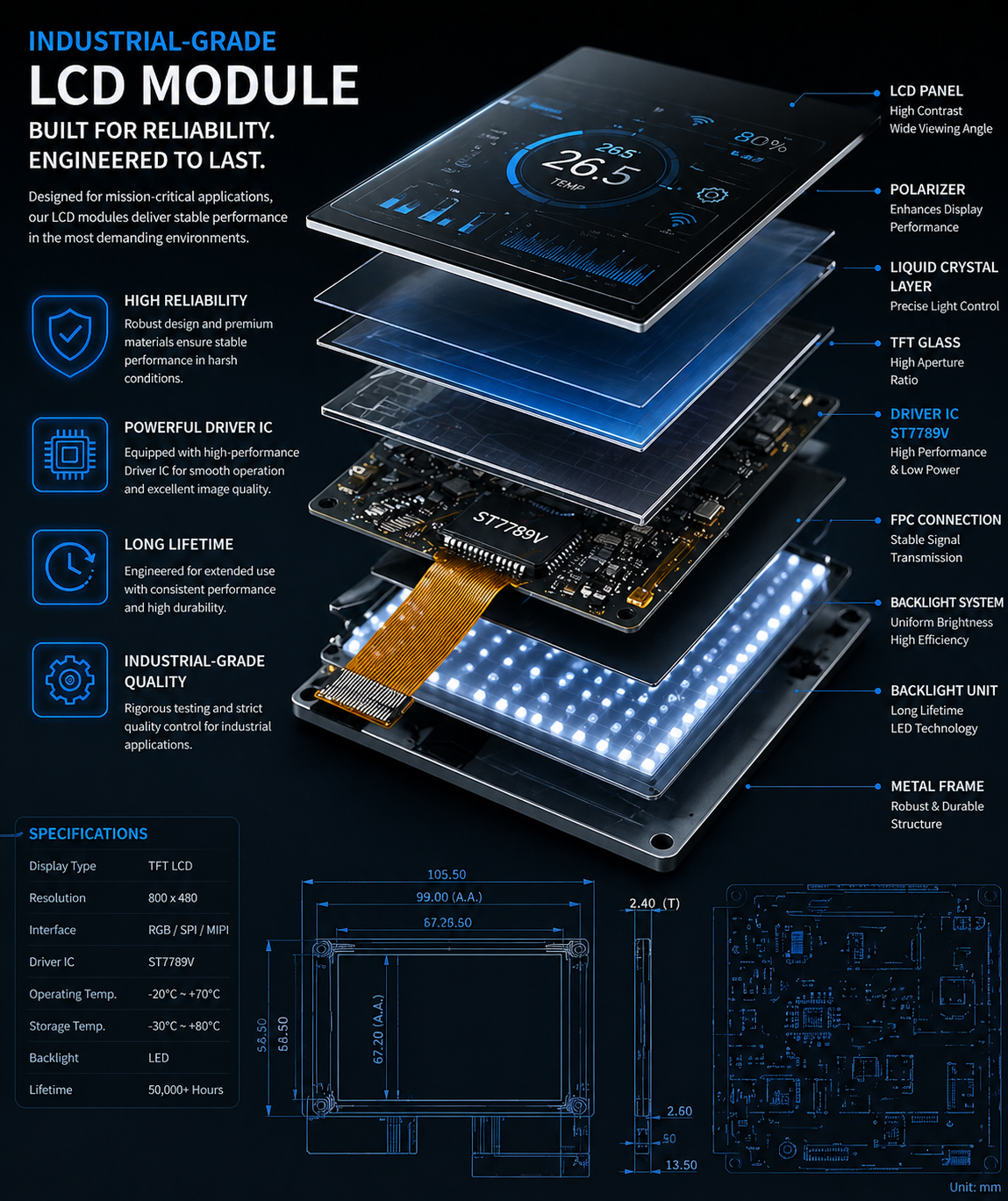
Clear visibility is essential in medical environments where accurate data interpretation is critical. Displays must remain readable under various lighting conditions, including hospital rooms with strong overhead lighting.
Important factors include:
IPS panels are commonly used in medical displays due to their stable color performance and wide viewing angles, which allow multiple users to view the screen simultaneously.
In certain medical applications, such as imaging or diagnostics, color accuracy is extremely important. Even small variations in color reproduction can affect how medical data is interpreted.
Key considerations include:
While not all medical devices require high-end imaging displays, maintaining consistent visual performance is still important across most applications.
Many modern medical devices use touchscreen interfaces to simplify operation and improve usability. Touchscreen integration must be reliable and suitable for clinical environments.
Common touch technologies include:
Capacitive touch provides a smooth user experience and supports multi-touch gestures. Resistive touch may still be used in environments where users wear gloves or require precise input.
Touch performance must remain stable under frequent use and different environmental conditions.
Medical devices may operate in different environments, including laboratories, ambulances, or outdoor healthcare settings. Displays must be able to function reliably across a range of temperatures and conditions.
Durability requirements may include:
Protective cover glass and proper enclosure design help improve long-term durability.
Medical devices are subject to regulatory requirements that vary by region and application. While the display itself may not always require certification, it must support the overall compliance of the device.
Considerations may include:
Working with experienced LCD manufacturers can help ensure that display modules meet the necessary quality and documentation requirements.
Medical devices typically have long product lifecycles, often exceeding five to ten years. Therefore, display availability and supply stability are critical.
Engineers and procurement teams should confirm:
Some manufacturers offer second-source solutions to reduce supply chain risks.

Displays for medical devices must meet high standards in reliability, visibility, durability, and lifecycle support. By carefully evaluating brightness, color performance, touchscreen integration, environmental durability, and supply stability, engineers can select LCD modules that meet the demanding requirements of medical applications.
Partnering with an experienced LCD manufacturer ensures that medical display solutions are reliable, compliant, and suitable for long-term deployment.
Looking for LCD displays for medical devices?
We provide reliable display solutions designed for medical and healthcare applications.
Our capabilities include:
RFQ Information
Please provide the following details:
Our engineering team will recommend a suitable display solution for your medical application.
Industrial LCD Lifetime and Reliability: What Engineers Should Know
LVDS vs MIPI vs RGB Interface Comparison for LCD Displays
How to Design Sunlight Readable LCD Displays for Outdoor Devices