
In today’s booming wearable tech market—from fitness trackers to medical patches—the display is one of the most critical components. It determines not only how users interact with the device but also impacts battery life, form factor, and user experience.
OLED modules, especially small-format monochrome and color variants, are often marketed as ideal for wearables. But are they really the best choice for industrial, medical, or long-life embedded wearables?
As a professional TFT LCD module manufacturer, FlyLucky compares OLED and alternative display technologies to help developers make the right call for performance, power, and product longevity.
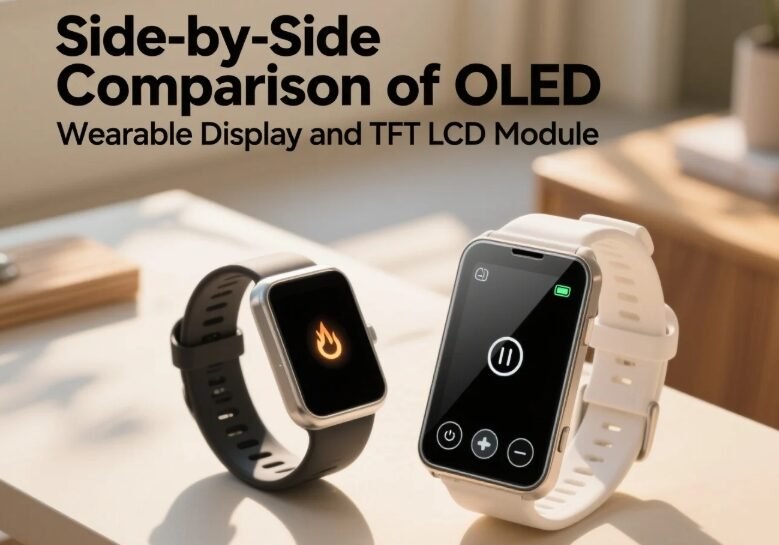
| Feature | OLED Modules | TFT LCD Modules |
|---|---|---|
| 🔋 Power Efficiency | Excellent for dark interfaces | Can be optimized via backlight dimming |
| 📐 Size & Flexibility | Ultra-thin, curved form factors | Slightly thicker, rigid formats |
| 🌡 Temperature Range | Limited: 0°C to +50°C | Wide range: –30°C to +85°C |
| 🧿 Visibility | Poor in sunlight | High brightness for outdoor use |
| 🔄 Lifespan | Burn-in risk in static UIs | Long-lasting with no ghosting |
| 💰 Cost | High for custom or full-color OLED | Lower cost for mass production |
| ⚙️ Interface Support | SPI/I2C for PMOLED; limited RGB/MIPI | Full range: SPI, MCU, RGB, MIPI, LVDS |
| 🔩 Customization | Shape flexible, integration limited | Fully customizable module design |
OLED (Organic Light-Emitting Diode) technology lights up individual pixels directly—no need for a backlight. This allows OLEDs to deliver perfect blacks, flexible form factors, and low power consumption in certain scenarios.
However, their organic compounds degrade faster under exposure to UV, heat, or prolonged static images—making them more suited for consumer-grade than industrial-grade wearables.
1️⃣ Define Usage Timeframe
Short-term wearable? → OLED
Long-term, frequent-use? → TFT LCD
2️⃣ Evaluate Power Profile
OLED saves power on black backgrounds, but not on bright UIs.
3️⃣ Assess Operating Conditions
If exposed to sunlight, heat, or physical impact → choose rugged LCD.
4️⃣ Check Interface Requirements
OLEDs are mostly SPI/I2C; TFT LCDs support broader formats like MCU, MIPI, RGB.
5️⃣ Consider Customization Needs
Need touch, cover lens, logo printing? TFT LCDs are easier to customize.
Q: Can OLED displays work in industrial wearables?
A: Possible, but not ideal—TFT LCDs handle temperature, lifespan, and impact better.
Q: Is burn-in still an issue with OLED?
A: Yes. Prolonged static images or status bars will leave image retention over time.
Q: What’s the thinnest TFT LCD module you offer?
A: FlyLucky provides modules under 2mm thickness, ideal for slim wearables.
Q: Can OLED and LCD be mixed in one product line?
A: Yes. Many customers use OLED for consumer version, LCD for pro version.
FlyLucky — Display Reliability That Moves With You
OLED may look sleek, but it’s not always the best choice for your wearable project. At FlyLucky, we help you weigh power, durability, visibility, and lifetime to choose the best-fit display—whether that’s OLED, TFT LCD, or hybrid.
👉 How to Avoid Shipment Delays During Peak Seasons: A B2B LCD Manufacturer’s Guide