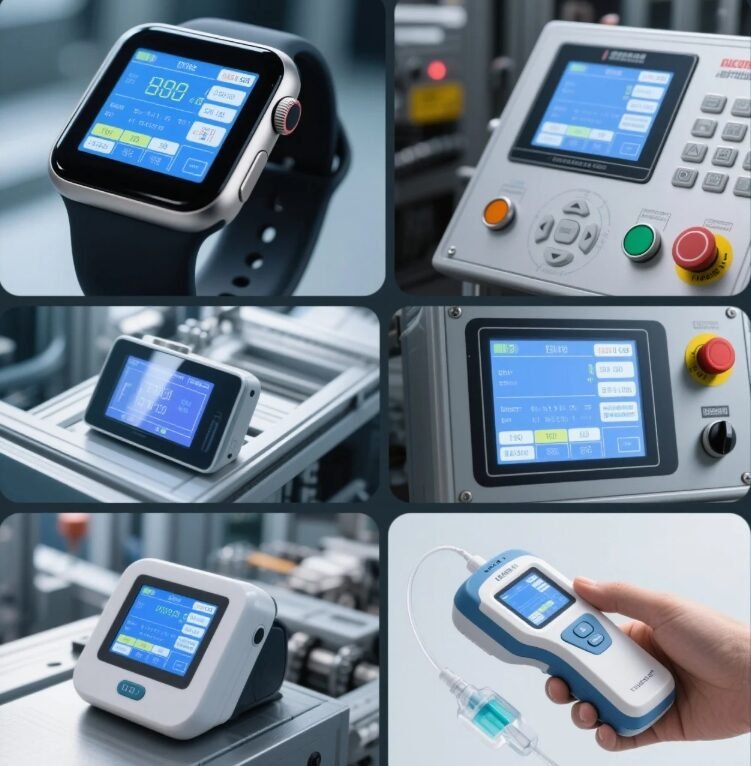
A Practical Guide for Engineers, Product Designers, and Procurement Teams
Introduction
Choosing the right TFT display size is a critical decision in industrial control system design. Among all options, 4.3-inch and 7-inch TFT displays are the most widely used sizes in embedded HMIs (Human-Machine Interfaces).
The decision is not just about screen size—it directly impacts UI usability, enclosure design, cost, power consumption, and system integration complexity.
This article provides a practical comparison to help engineers and procurement teams select the right display size for industrial applications.
Why Display Size Matters in Industrial Systems
Industrial control systems depend heavily on clear and reliable visual interaction. The display directly affects:
Operator efficiency
Information readability
System safety
Mechanical design constraints
Cost structure
Incorrect sizing can lead to redesigns, poor usability, or increased BOM costs.
Industry Applications
Overview: 4.3″ vs 7″ TFT Displays
4.3-inch TFT Display
The 4.3-inch TFT is a compact industrial display widely used in space-constrained devices.
Typical characteristics:
Resolution: 480×272 or 800×480
Brightness: ~250–500 nits
Interface: RGB / SPI / MIPI
Ideal for short viewing distance applications
It is considered a “golden small-screen” size for embedded systems due to its balance of cost, size, and usability.
7-inch TFT Display
The 7-inch TFT is the standard industrial HMI size, offering better UI space and readability.
Typical characteristics:
Resolution: 800×480 or higher (WVGA–FHD variants)
Brightness: 350–1000 nits (industrial grade)
Interface: RGB / LVDS / MIPI DSI
Designed for multi-function control panels
It is widely considered a “sweet spot” size for industrial and embedded HMIs.
Key Comparison Factors
1. UI Complexity & Information Density
4.3″ TFT: Best for simple UI
3–6 key parameters
Status screens, basic control
7″ TFT: Supports complex dashboards
Multi-zone control
Graphs, menus, real-time monitoring
👉 Rule of thumb: If your UI needs scrolling or multiple pages → choose 7″
2. Mechanical Design Constraints
4.3″ = compact, ideal for handheld or tight enclosures
7″ = requires larger front panel and deeper enclosure
Many industrial devices choose 4.3″ simply due to PCB + enclosure limitations.
3. Power Consumption
4.3″ TFT → lower backlight power, better for battery devices
7″ TFT → higher brightness and power demand
For portable or energy-sensitive devices, 4.3″ is preferred.
4. Viewing Distance & Ergonomics
4.3″: close-range interaction (0.3–0.6m)
7″: operator panel (0.5–2m viewing distance)
Industrial HMI ergonomics strongly favor 7″ for factory environments.
5. Interface & System Complexity
4.3″: often RGB or SPI (simpler systems, fewer features)
7″: LVDS or MIPI (higher performance, more bandwidth)
Larger displays typically require more advanced interface support and driver IC integration.
6. Cost Considerations
4.3″ → lower BOM cost, simpler integration
7″ → higher cost but better UI capability
However, system cost also includes:
Enclosure redesign
PCB routing complexity
Software UI development
So total cost difference is not just panel price.
When to Choose 4.3″ TFT Displays
Choose 4.3-inch displays when:
Device is compact or handheld
UI is simple (status, numbers, basic control)
Power consumption is critical
Cost sensitivity is high
Space is limited
Typical applications:
Portable testers
Small industrial controllers
IoT terminals
Auxiliary displays
When to Choose 7″ TFT Displays
Choose 7-inch displays when:
Multi-function UI is required
Operators need better visibility
Industrial automation panels
Touch-based control systems
Complex data visualization is needed
Typical applications:
PLC control panels
Factory HMIs
Industrial automation systems
Smart equipment dashboards
Engineering Decision Framework
A practical selection rule:
If UI = simple + compact → 4.3″ TFT
If UI = interactive + multi-layer → 7″ TFT
Also consider:
Viewing distance
Touch interaction frequency
System expansion needs
Common Mistakes in Selection
Choosing screen size based only on cost
Ignoring UI complexity growth
Not considering enclosure constraints early
Underestimating interface bandwidth needs
Overlooking brightness requirements for factory environments
Conclusion
The choice between 4.3-inch and 7-inch TFT displays is not about which is better—it is about system fit.