
Understanding LCD Backlight Evolution, Architecture, and Engineering Design for Industrial TFT Applications
Table of Contents
Behind every TFT LCD module is a component users rarely think about but engineers consider critical — the backlight system.
Unlike OLED displays that generate light from individual pixels, LCD panels cannot emit light by themselves. They rely entirely on an external light source to illuminate the screen. As display technology evolved, LCD backlight systems transformed from bulky fluorescent tubes into highly efficient solid-state lighting solutions.
Over the past two decades, the transition from CCFL (Cold Cathode Fluorescent Lamp) to WLED (White Light Emitting Diode) has fundamentally reshaped display performance, energy efficiency, product design, and industrial applications.
For engineers and purchasing teams selecting display solutions, understanding the differences between these technologies can directly affect product reliability, power consumption, brightness performance, and long-term maintenance costs.
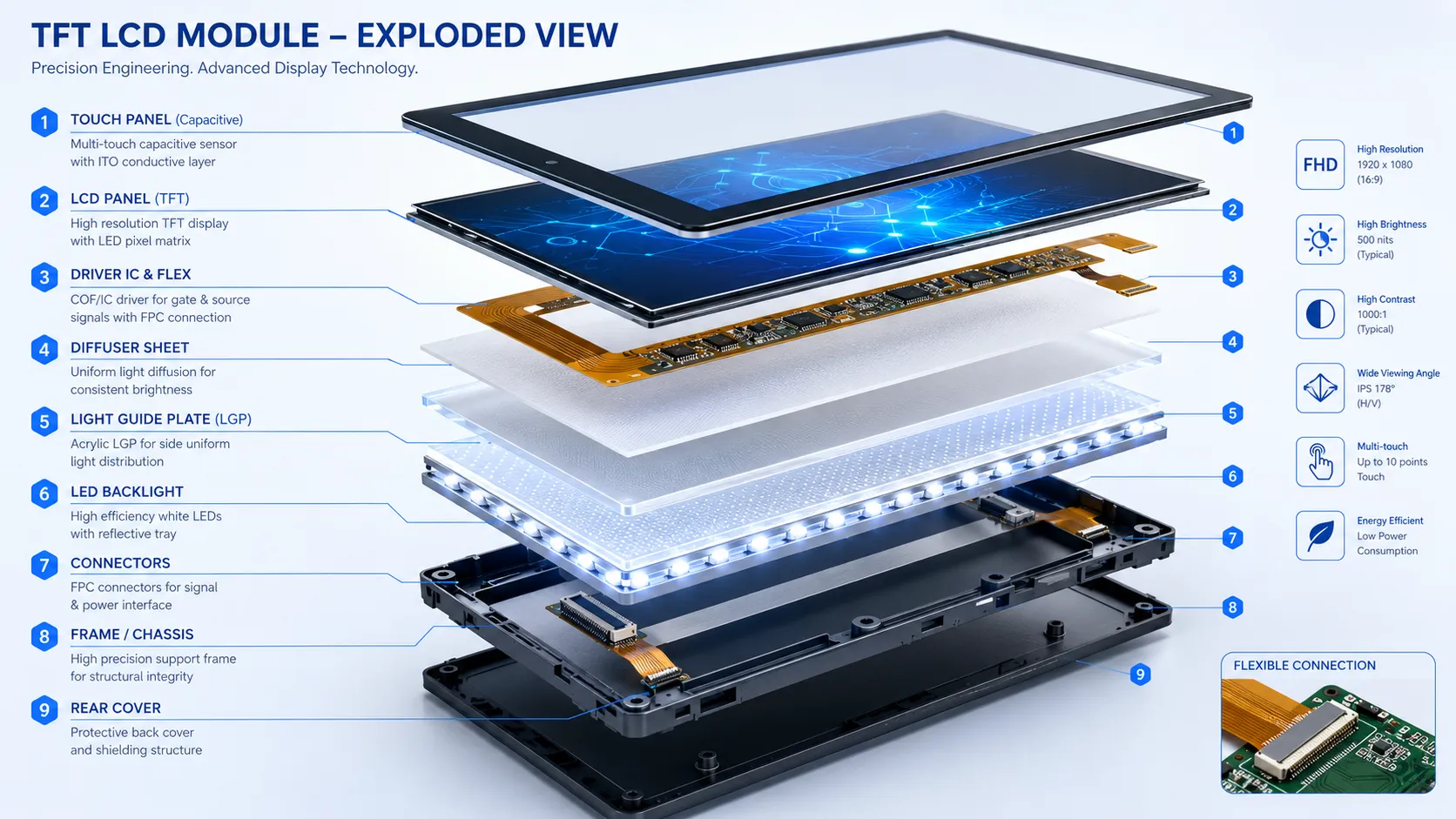
Image Placement Suggestion
Prompt:
Exploded view of TFT LCD module showing LCD panel, LED backlight unit, light guide plate, diffuser layers, touch panel and driver IC, engineering visualization, ultra detailed, blue and white technology style
Early LCD displays relied heavily on CCFL backlighting technology, particularly in desktop monitors, industrial equipment, televisions, and notebook computers.
The technology worked by applying high-voltage electrical energy to mercury vapor inside a glass tube. The resulting ultraviolet radiation activated phosphor coatings inside the tube and produced visible white light.
At the time, CCFL represented a major breakthrough in display illumination. It offered relatively stable brightness and excellent color performance.
However, as demand increased for:
CCFL technology gradually revealed its limitations.
The arrival of WLED completely changed the display industry.
Instead of gas discharge principles, WLED uses semiconductor devices. A blue LED chip excites yellow phosphor material to create white light.
This transition marked a significant technological leap:
From:
Gas discharge lighting
To:
Solid-state lighting
Today nearly all TFT LCD modules, industrial displays, laptops, automotive displays, and mobile devices use LED backlighting.
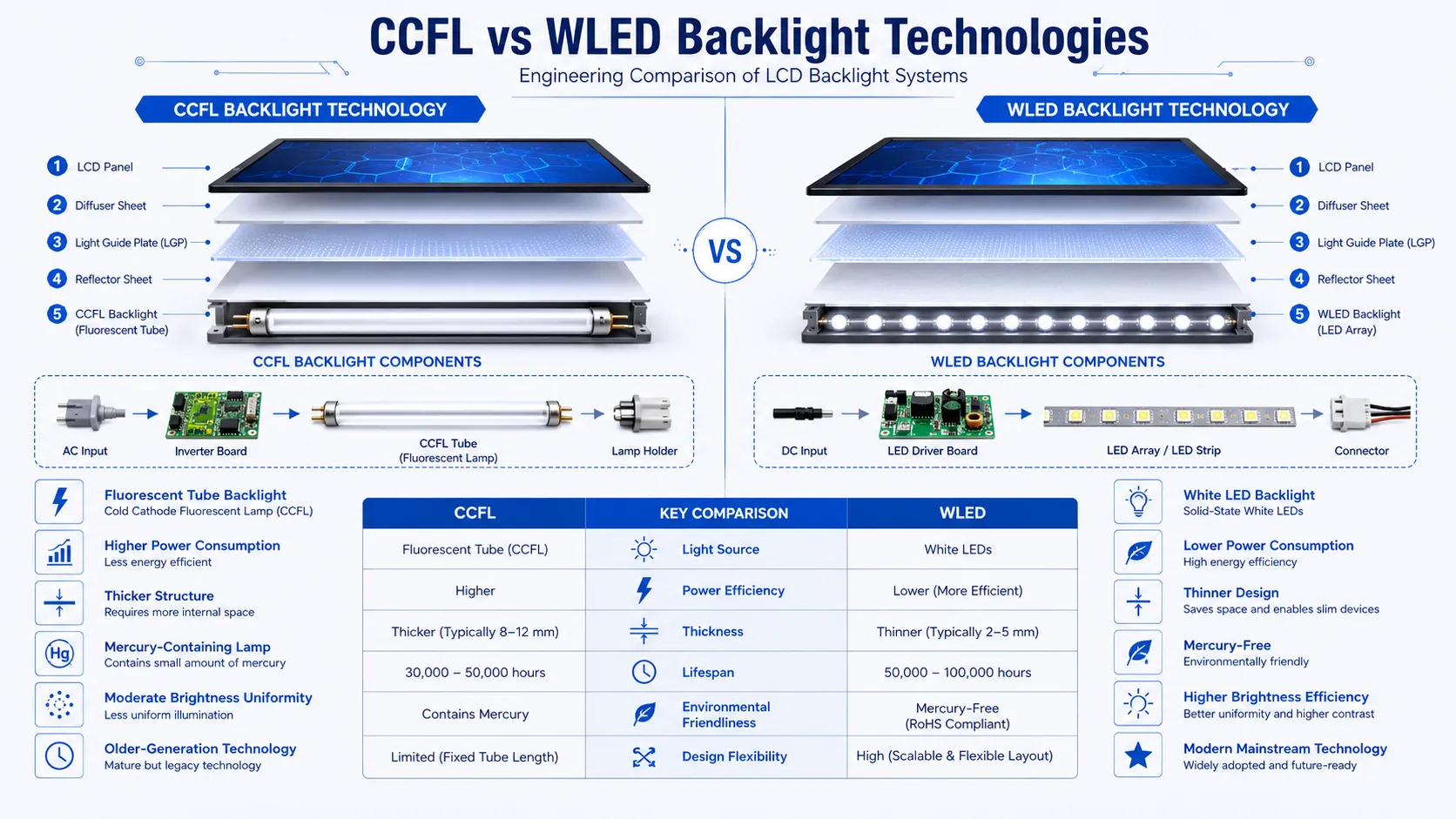
The transition was not merely a replacement of light sources—it represented improvements across multiple engineering dimensions.
| Parameter | CCFL | WLED |
|---|---|---|
| Light source | Gas discharge tube | Semiconductor LED |
| Operating voltage | 600V+ AC | Low-voltage DC |
| Power efficiency | Lower | 20–50% higher |
| Thickness | Large tube structure | Ultra-thin |
| Lifetime | ≈35,000 hours | 50,000+ hours |
| Mercury content | Contains mercury | Mercury-free |
| Heat generation | High | Low |
| Brightness control | Limited | Excellent |
| Local dimming support | No | Yes |
Energy efficiency became one of the largest driving forces behind LED adoption.
CCFL systems lose significant energy through:
WLED backlights typically reduce power consumption by 20–50%, making them ideal for:
For products operating continuously, lower energy use also reduces heat generation and increases overall system reliability.
CCFL contains mercury.
Mercury is a hazardous heavy metal that poses serious environmental concerns.
Its characteristics include:
By contrast, LED technology eliminates mercury entirely and aligns with modern environmental requirements.
CCFL tubes typically have diameters around 2–3 mm and cannot easily bend.
LED chips, however, are extremely compact.
This allows engineers to create:
Modern display industrial design would be difficult without LED technology.
Image Placement Suggestion
Prompt:
Split-screen comparison between CCFL fluorescent tube and WLED LED array, industrial engineering infographic style, clean blue and white layout
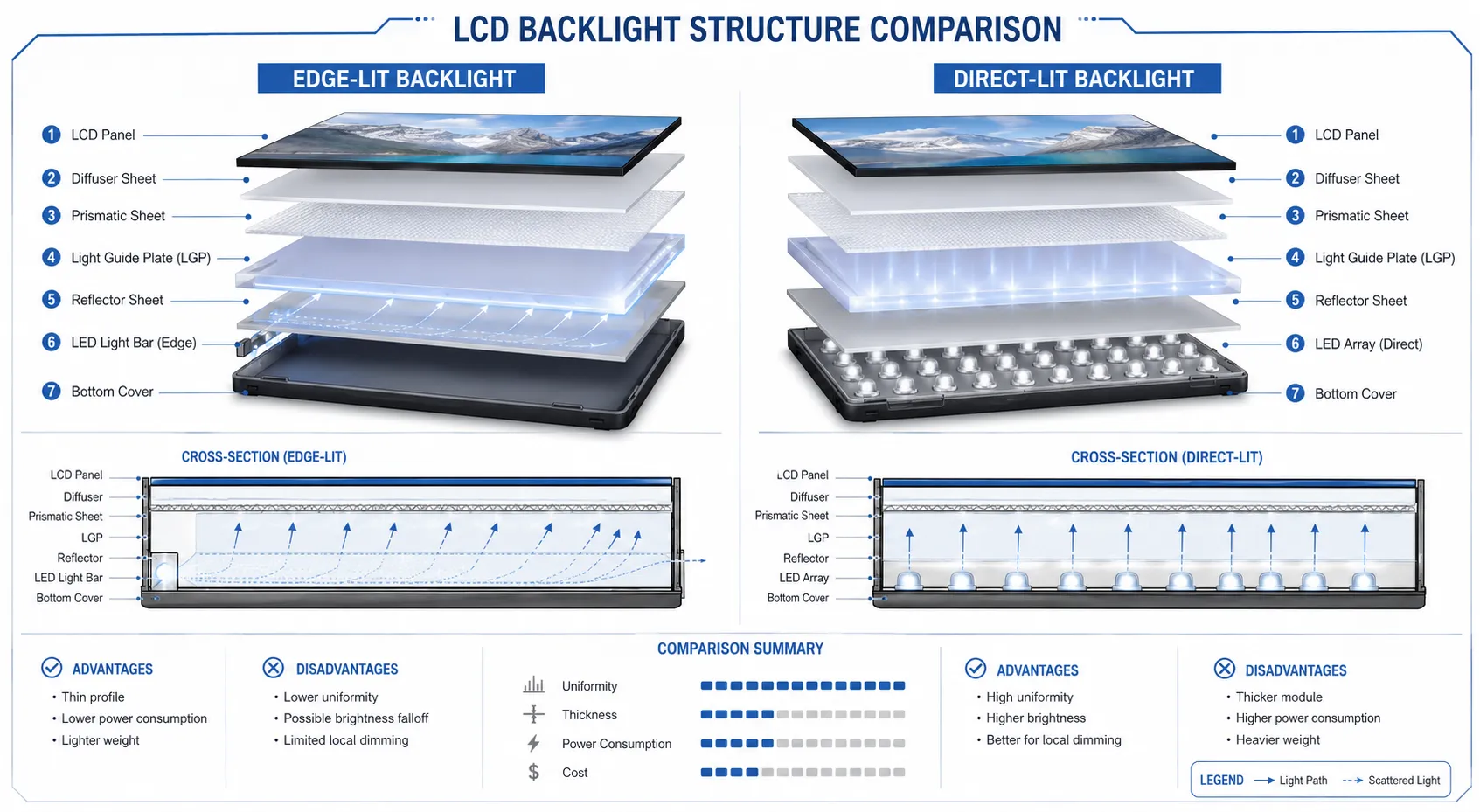
Although WLED became the mainstream solution, LED arrangement itself introduced multiple design approaches.
The two most common architectures are:
In edge-lit systems, LED strips are placed along the display edges.
Common locations include:
Light enters a light guide plate (LGP) and spreads evenly across the display.
Advantages:
✔ extremely thin design
✔ lightweight structure
✔ lower material cost
✔ ideal for portable products
Applications:
However, edge-lit structures have limitations.
Because light must travel through the guide plate, achieving perfectly uniform brightness becomes challenging.
Engineers often encounter:
Direct-lit systems place LED arrays directly behind the display panel.
Advantages include:
✔ higher brightness
✔ stronger HDR performance
✔ better contrast ratio
✔ flexible local dimming
Applications:
The trade-off is increased:
Image Placement Suggestion
Prompt:
LCD backlight architecture comparison showing Edge-lit and Direct-lit structures with LED positions and light guide plates, engineering cross-sectional illustration
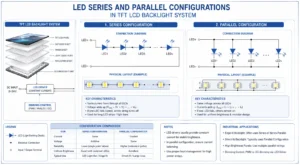
Another often-overlooked engineering consideration involves LED connection methods.
Manufacturers frequently describe LCD backlights using terms like:
6S2P
or
8S3P
These numbers indicate LED arrangement.
S = Series
P = Parallel
For example:
6S2P means:
Total LED quantity:
6 × 2 = 12 LEDs
If each LED requires:
3.2V
Then:
Driving voltage:
6 × 3.2 = 19.2V
Current:
20mA × 2 = 40mA
Advantages:
✔ better brightness consistency
✔ higher power efficiency
✔ easier current matching
Advantages:
✔ lower voltage requirement
✔ simpler safety design
Engineers must balance:
Image Placement Suggestion
Prompt:
LED series and parallel backlight configuration inside TFT LCD module, engineering schematic style, industrial visualization
Consumer displays and industrial displays have completely different design priorities.
Consumer products emphasize:
Industrial systems prioritize:
Outdoor environments often require brightness levels above:
1000–2000 nits
At higher brightness levels, engineers face several challenges:
Higher LED current generates heat.
Excess heat can accelerate:
Higher brightness increases energy demand.
Portable systems require optimized efficiency.
As brightness rises, uneven lighting becomes more noticeable.
Design optimization may include:
These factors explain why industrial TFT displays frequently cost more than consumer displays.
Many industrial projects require custom optimization instead of standard products.
For engineers selecting TFT LCD modules, several questions should be considered:
Standard edge-lit WLED typically works well.
High-brightness direct-lit architecture is recommended.
Prioritize high-efficiency LED configurations.
Industrial-grade LED solutions generally outperform consumer designs.
Select displays validated under:
-30°C to +85°C industrial conditions.
Selecting the wrong backlight architecture can increase:
Backlight design should be considered early during product development.
WLED offers lower power consumption, longer lifespan, thinner structures, and environmentally friendly materials.
CCFL is largely obsolete and rarely used in modern displays.
Direct-lit WLED with high brightness levels typically provides superior performance.
It refers to six LEDs connected in series with two parallel LED strings.
The evolution from CCFL to WLED transformed the display industry and enabled thinner, brighter, and more energy-efficient TFT LCD modules.
Beyond simply providing illumination, backlight architecture directly influences:
For industrial applications, selecting the correct backlight structure and LED configuration is no longer optional—it is a key engineering decision.
As display requirements continue evolving toward higher brightness, lower power consumption, and smarter local dimming capabilities, WLED technology remains at the center of modern TFT LCD innovation.
Looking for custom TFT LCD module solutions with high brightness, wide temperature support, and optimized backlight design?
Our engineering team supports OEM and custom display development from concept to mass production. Contact us for tailored industrial display solutions.