
In real-world projects, one of the most common questions from clients is:
“Should I choose LVDS, MIPI, or RGB (TTL) for my display interface?”
From an engineering perspective, the difference is not in the LCD panel itself, but in:
- Signal transmission method
- Noise immunity
- System complexity
- Hardware design constraints
Let’s break it down in a practical, decision-oriented way.
🧠 Quick Decision Guide (TL;DR)
- RGB (TTL) → Simple & low cost, but weak anti-interference → Best for low resolution, short distance
- LVDS → Stable & robust → Best for industrial and medium–large displays
- MIPI DSI → High-speed & low power → Best for smartphones & high-resolution devices
⚙️ 1. Core Technical Differences
1️⃣ RGB (TTL) Interface — Parallel Raw Data
- Uses multiple data lines for R/G/B (6–8 bits each)
- Requires control signals: HSYNC / VSYNC / DE / CLK
- Parallel interface
👉 Engineer’s view:
The host directly sends pixel data to the panel without complex encoding.
✔ Pros:
- Simple implementation
- Low cost
- Easy debugging
❌ Cons:
- Too many wires (20–30+ pins)
- Poor EMI performance
- Very limited cable length (<20 cm recommended)
2️⃣ LVDS Interface — Differential Serial Transmission
- Converts parallel RGB → serialized data
- Uses low-voltage differential signals
👉 Engineer’s view:
Compress multiple signals into fewer high-speed differential pairs for stability.
✔ Pros:
- Strong noise immunity
- Low EMI
- Supports longer cable distance (1m+)
❌ Cons:
- Requires serializer/deserializer
- Slightly higher cost than RGB
3️⃣ MIPI DSI — High-Speed Mobile Interface
- High-speed serial communication with multiple lanes
- Based on D-PHY / C-PHY architecture
👉 Engineer’s view:
Designed for high bandwidth + low power in compact devices.
✔ Pros:
- Extremely high data rate
- Very low power consumption
- Minimal pin count
❌ Cons:
- Complex development
- Requires SoC support
- Strict PCB layout requirements
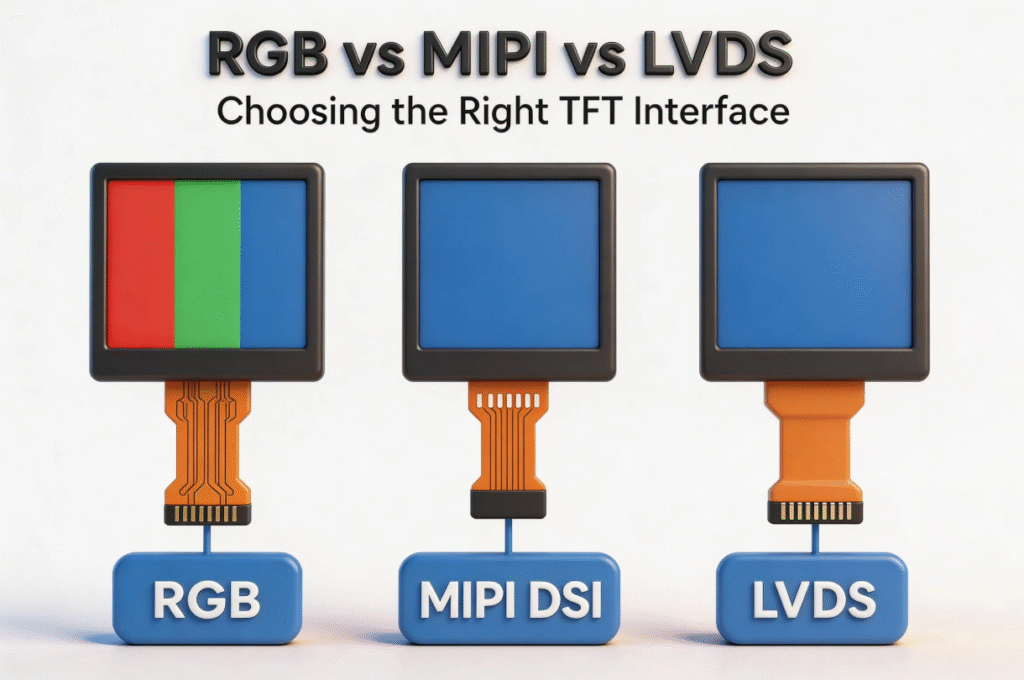
📊 2. Key Comparison Table
| Parameter | RGB (TTL) | LVDS | MIPI DSI |
|---|---|---|---|
| Transmission | Parallel | Differential Serial | High-Speed Serial |
| Signal Type | Single-ended | Differential | Differential |
| Noise Immunity | ❌ Weak | ✅ Strong | ✅ Excellent |
| Pin Count | ❌ High (20+) | ✅ Medium | ✅ Low |
| Cable Length | ❌ Short | ✅ Long | ❌ Short (on-board) |
| Power Consumption | ❌ High | Medium | ✅ Low |
| Resolution Support | ❌ Low | ✅ Medium–High | ✅ Ultra High |
| Typical Resolution | ≤800×480 | ≤1920×1080 | 2K / 4K+ |
| Cost | ✅ Low | Medium | ❌ High |
| Typical Use | Basic MCU systems | Industrial devices | Smartphones/tablets |
🧩 3. Engineering Pitfalls (What Actually Causes Problems)
⚠️ Why RGB Often Fails in Real Products
- Parallel signals require tight timing alignment
- Trace mismatch → skew & jitter
- High EMI → certification issues (CE/FCC)
👉 Conclusion:
RGB is fine for simple designs, but risky for complex systems.
⚠️ Why LVDS is the Industrial Standard
- Differential signaling cancels noise
- Lower EMI → easier certification
- Reliable over longer distances
👉 Conclusion:
LVDS is the safest choice for B2B/industrial applications.
⚠️ Why MIPI is Powerful but Difficult
- Requires compatible processor (SoC)
- Debugging involves both protocol + physical layers
- Strict impedance & routing rules
👉 Conclusion:
MIPI is not “hard” — it just has a higher entry barrier and cost.
🚀 4. Practical Selection Guide
✔ Choose RGB (TTL) if:
- Resolution ≤ 800×480
- Using MCU (e.g., STM32)
- Very cost-sensitive
- Short PCB connection
✔ Choose LVDS if (Most Recommended for B2B):
- Display size: 7”–21”
- Resolution: 1024×600 to 1920×1080
- Industrial / medical / HMI applications
- Requires stability & longer cable
👉 💡 Best balance of cost, stability, and performance
✔ Choose MIPI DSI if:
- Resolution ≥ 1080P
- Using Android / Linux platforms (RK, MTK, Qualcomm)
- Space-constrained device
- Power efficiency is critical
💬 5. Engineer’s Closing Summary (Client-Friendly)
The difference between RGB, LVDS, and MIPI is not about the display panel itself, but how the data is transmitted.
RGB is the simplest but least robust;
LVDS offers the best balance of stability and cost for industrial applications;
MIPI delivers the highest performance but requires more advanced system design.For most B2B and industrial projects, LVDS is usually the most reliable and practical choice.
🔥 FAQ
❓ What is the difference between LVDS and RGB interface?
LVDS uses differential signaling for better noise immunity and longer transmission distance, while RGB (TTL) uses parallel signals, making it simpler but more sensitive to interference.
❓ Is MIPI better than LVDS?
MIPI offers higher speed and lower power consumption, but requires more complex design and SoC support. LVDS is more stable and widely used in industrial systems.
❓ Which LCD interface is best for industrial applications?
LVDS is typically the best choice due to its balance of stability, EMI performance, and cost.
❓ When should I use RGB (TTL)?
RGB is suitable for low-resolution displays, short-distance connections, and cost-sensitive embedded designs.
Not sure which interface is right for your project?
Contact our engineering team for a customized LCD solution (LVDS / MIPI / RGB supported).Analog vs Digital LCD: Signal Architecture, TFT Interfaces, and Engineering Trade-offs
Display Cost Structure Breakdown: Where Your LCD Budget Really Goes
Second Source Strategy for Displays: How Engineers Reduce Supply Chain Risks
LCD Module RFQ Guide: How to Get Accurate Quotes and Reliable Suppliers